
DG CAA — Passenger Feedback Across 4 Airports
Comprehensive passenger satisfaction system covering Sofia, Varna, Burgas, and Plovdiv airports — analyzing every touchpoint from check-in to landing
The Challenge
Before BlitzPoll, Bulgaria's four international airports relied on sporadic paper-based surveys that yielded poor response rates and fragmented data. There was no centralized system for collecting, comparing, or acting on passenger feedback. Each airport operated in isolation, with no standardized methodology for measuring service quality.
The absence of real-time data meant that management decisions about capital investments, staffing, and service improvements were based on assumptions rather than evidence. Terminal comparisons were impossible, seasonal trends went undetected, and there was no mechanism to track whether corrective actions actually improved the passenger experience.
With millions of passengers passing through Sofia, Varna, Burgas, and Plovdiv each year — including a significant share of international travelers — the Directorate General of Civil Aviation Authority needed a scalable, multilingual solution that could operate across all four airports simultaneously.
The Solution
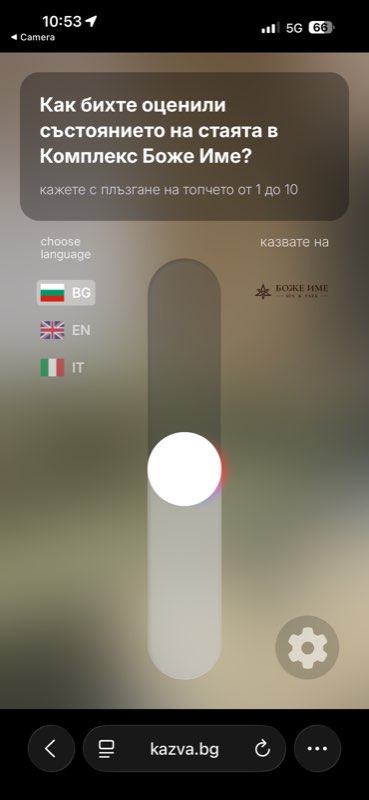
BlitzPoll QR codes were deployed at every passenger touchpoint across all four airports — check-in counters, security checkpoints, departure gates, restrooms, boarding areas, and arrival halls. A total of 21 assessment zones were defined, enabling granular analysis of each stage of the passenger journey. The questionnaires are available in Bulgarian, English, German, and Russian, ensuring that both domestic and international passengers can participate effortlessly.
Each airport received a dedicated real-time dashboard, giving local management immediate visibility into passenger satisfaction scores, complaint volumes, and trending issues. At the national level, the DG CAA gained a unified view for cross-airport benchmarking — comparing terminal performance, identifying systemic issues, and tracking improvement over time.
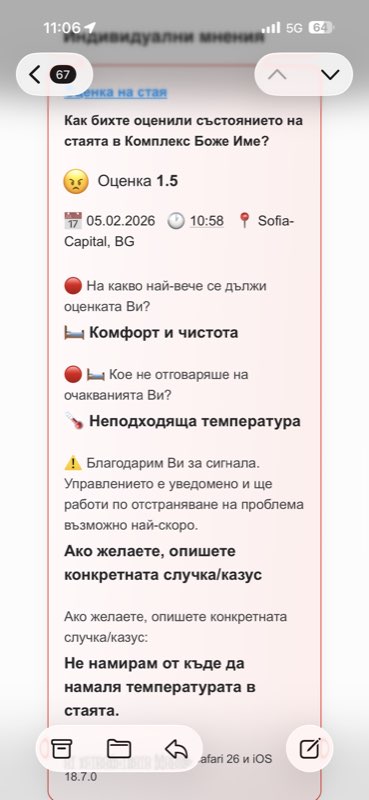
Automated weekly reports are generated and distributed to stakeholders, including NPS scores, satisfaction trend analysis, terminal-by-terminal comparisons, and priority alerts for zones that fall below defined thresholds. Negative feedback triggers instant email notifications to the responsible manager, enabling rapid response to individual passenger concerns.
Gallery
Results
Over 300,000 passenger surveys have been collected and analyzed across all four airports, creating the largest structured dataset of passenger experience in Bulgarian aviation history. The volume and consistency of data transformed how the DG CAA approaches infrastructure planning and service delivery.
Terminal-by-terminal comparison enabled data-driven capital investment decisions for the first time. Sofia Airport's Terminal 2 renovation priorities were directly informed by passenger feedback data, ensuring that the areas with the lowest satisfaction scores received attention first. Similar data-driven improvements were implemented at Varna and Burgas during peak summer season operations.
Response time to passenger complaints improved from weeks to hours. Managers now receive real-time alerts and can address issues before they escalate into public complaints or social media incidents. The system has become an integral part of airport operations, with monthly reports used in management review meetings across all four airports.
More case studies
BORICA — Employee Intelligence
Continuous employee feedback with individual QR codes for anonymous assessment. The +95 NPS score wasn't the goal — the driver analysis behind it informed restructuring of 3 internal service lines and shaped the HR strategy.
RetailMinimart — 350+ Stores
Always-on customer intelligence across all locations. Weekly trend analysis and employee performance tracking allow regional managers to make data-driven decisions — identifying top performers and stores that need attention.
MunicipalMunicipality of Stara Zagora — BlitzPoll
Direct connection between citizens and local government — covering 51 settlements. Feedback on playgrounds, transport, and urban environment drives municipal planning priorities. Recognized as a Top 9 European innovation in digital governance.